Understanding the Range of Voices and Expertise in Career Guidance
Share this
Navigating the Landscape of Career Guidance Providers
In today’s complex and rapidly changing world of work, individuals are increasingly seeking support for career decisions, job transitions, and professional growth. The field of career guidance has expanded far beyond the classic “career counsellor,” now encompassing a wide variety of practitioners—including career coaches, mindset trainers, life coaches, mental health counselors, and, most recently, industry experts and social media influencers who share advice online.
With so many voices available, how can career seekers make informed decisions about whose advice to trust? The answer lies in understanding the spectrum of roles in career support, the credentials and ethical boundaries that define them, and the critical role of evidence-based practice in safeguarding the quality of career interventions.
Certified and Regulated Practitioners: The Foundation of Professional Career Guidance
Professional career counsellors and career coaches form the backbone of regulated career support. These practitioners are typically trained to offer evidence-based interventions, working within clear ethical frameworks centered on client autonomy, confidentiality, and non-directiveness. Academic or professional certifications, such as degrees in career counselling or international coaching accreditations (e.g., ICF, EMCC), ensure a high standard of competence, and many countries require practitioners to adhere to codes of practice and ongoing supervision. 1
Globally, the International Association for Educational and Vocational Guidance (IAEVG) provides ethical guidelines and promotes international standards across the career development field, supporting quality assurance and professional development for practitioners worldwide.
Career counsellors utilise recognised frameworks, including trait-factor theories, constructivist approaches and the life design paradigm, to support individuals in career exploration, employability skills and transitions. Career coaches, when similarly accredited, focus on goal-setting, motivation and action planning, drawing on positive psychology and solution-focused techniques. Importantly, these roles are held to accountability standards designed to protect clients and foster measurable outcomes.
Blended and Unregulated Roles: New Frontiers and Grey Zones
Expanding client interest in personal development and holistic well-being has fueled the emergence of roles such as life coaches, mindset trainers, mental health counsellors engaging in career discussions, and practitioners using models like NLP (Neuro-Linguistic Programming). While many bring valuable perspectives, these roles are rarely regulated for career-specific competence. For instance, a life coach may provide motivation or confidence-building, but unless they are also trained in career development, their advice may lack academic or practical grounding for specific labor market realities.
Mental health counsellors, when supporting career issues, offer essential emotional resources, especially when mental health intersects with employability, but should refrain from providing concrete career diagnostics unless appropriately dual-trained. Mindset trainers and NLP practitioners focus on behaviors, beliefs and communication styles; their work may be helpful for self-efficacy but is not synonymous with professional career guidance.
The consequence of these blurred boundaries is that client outcomes may vary considerably depending on practitioner competence, ethical transparency, and the suitability of interventions. International research warns against “overstepping” when unqualified helpers apply interventions without sufficient understanding of career theory, market trends, or individual needs (Niles, Yoon, & Amundson, 2022).
Field Experts and Influencers: The Rise of Peer-Led and Experiential Advice
A distinct group of career advisors comes from outside professional practice—successful industry leaders, HR professionals, recruiters, educators, journalists, or social media influencers—who share personal stories and sector-specific advice. These voices offer inspiration and context, and their lived experience is undeniably valuable. However, their guidance, while often influential, should not be mistaken for systematic, client-centered career development.
Recent studies (Sampson et al., 2020) highlight that, although experiential learning and peer mentoring can indeed enhance adaptability and motivation, the uncritical acceptance of advice from charismatic experts or popular personalities often carries the risk of reinforcing biases, stereotypes, or overly simplistic approaches. In my practice as a Career Counsellor, I have repeatedly encountered clients who felt intimidated or inadequate when comparing themselves to the stature and achievements of such experts. As a result, the personal stories of these individuals often acted not as inspiration, but as a deterrent to my clients’ own progress.
Making Informed Choices: The Role of the Client
Ultimately, individuals benefit most when they proactively evaluate the background, credentials, and focus of those offering career support. Clients should look for transparency about training, ethical standards, and the boundaries of each practitioner’s expertise. Professional associations (e.g., National Career Development Association – NCDA, ICF) provide directories and guidelines for selecting qualified help.
In summary
The world of career guidance spans a continuum, from rigorously trained and regulated practitioners to blended and informal helpers, and onward to influential but unregulated field experts. Clients who “choose wisely” by favoring evidence-based, ethically grounded career support set the foundation for healthier, more meaningful career journeys.
References: Niles, S.G.; Yoon, H.J.; Amundson, N.E. (2022). Career Development Interventions. Sampson, J.P. et al. (2020). Training and Certification in Career Counseling. International Association for Educational and Vocational Guidance (IAEVG), Ethical Guidelines.
Graph “Who Supports Your Career”
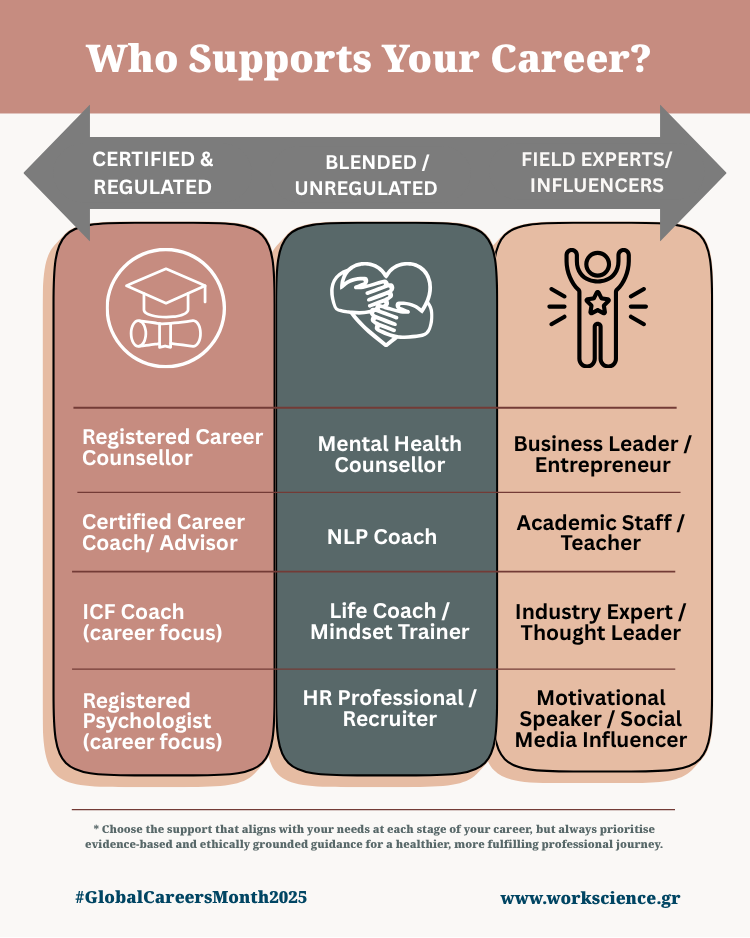
- In countries such as the United Kingdom, Ireland, Canada, Australia, New Zealand, the Netherlands, and the Scandinavian region (Sweden, Norway, Denmark, Finland), professional career practitioners are often regulated by national or regional bodies (e.g., the Career Development Institute in the UK, Canadian Council for Career Development, Australian Centre for Career Education) that require adherence to formal codes of ethics, annual continuing professional development, and regular supervision. In the United States, while regulation varies by state, certified career counselors (such as those credentialed by the National Career Development Association) are also bound by professional codes of practice.
In Greece, the National Organization for the Certification of Qualifications & Vocational Guidance (EOPPEP) maintains a formal registry of Certified Career Counselors (Σύμβουλοι Σταδιοδρομίας A), recognising diploma-level qualifications. However, currently, EOPPEP’s role is limited to initial registration, with no structured framework for ongoing professional development, supervision, or enforcement of practice standards.
↩︎